How to Actually Progress on a Mini Stepper
Quick Answer: A mini stepper plateaus because it has almost no built-in progression. Add difficulty with four things the machine does not provide: resistance bands held in the hands, a weighted vest or backpack, deliberate interval structure, and posture changes that shift load to the glutes. The single most effective change is intervals - 60 seconds fast, 90 seconds easy, repeated 8 to 10 times - because a mini stepper at a steady pace has a very low ceiling.
What the machine is genuinely good at is accumulating easy movement, and that is worth more than it sounds.
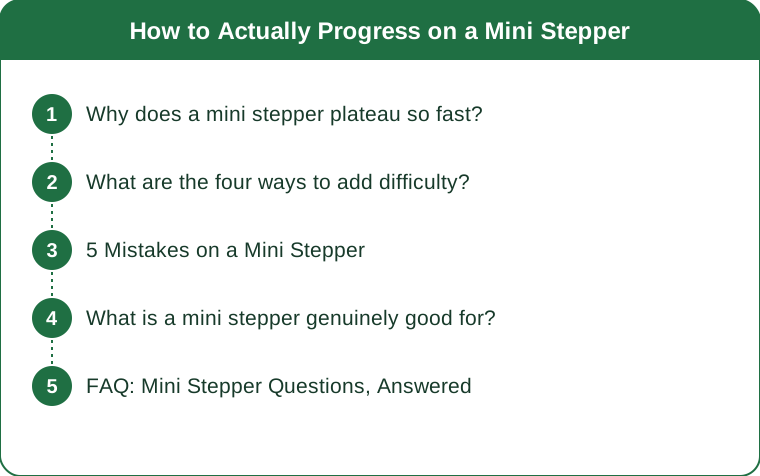
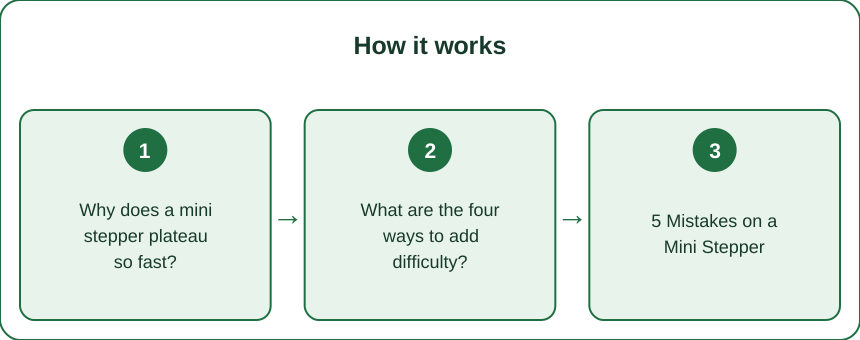
Why does a mini stepper plateau so fast?
Because it has a narrow range of difficulty and your body adapts through it quickly.
The resistance adjustment on most models is limited. Hydraulic cylinders provide a fairly narrow band, and turning the dial to maximum is a small change rather than a transformative one.
Range of motion is short by design. A step height of around 15 to 20cm means the muscles work through a limited range, which caps how much work each step can do.
Steady-state adapts fastest. Doing the same thing at the same pace for 20 minutes is precisely the stimulus your body optimises for. Within a few weeks the same session costs measurably less effort.
And the calorie display is not a progress marker. Machine calorie estimates are generic formulas that generally do not account for your weight, and they often read high. Watching the number go up is not evidence the session got harder.
The reframe: a mini stepper is an excellent NEAT machine and a mediocre training machine, unless you add difficulty from outside it. Both roles are legitimate - the mistake is expecting the second one for free.
What are the four ways to add difficulty?
In order of how much they change the session.
1. Intervals - the biggest lever. 60 seconds at the fastest sustainable cadence, 90 seconds easy, 8 to 10 rounds. This turns a low-ceiling steady session into a genuinely demanding one, and it costs nothing. Use a timer, not the machine’s display.
2. Resistance bands in the hands. Most mini steppers come with bands, and most people leave them in the box. Curls, presses, and rows while stepping add upper-body work and raise heart rate substantially. Bicep curls and overhead presses alternated every 30 seconds work well.
3. A weighted vest or a loaded backpack. 5 to 10kg changes the leg demand meaningfully and adds a bone-loading stimulus that the unloaded machine does not provide. Start light - the effect is larger than the number suggests.
4. Posture and foot position. Leaning very slightly forward from the hips with the weight through the heels shifts load toward the glutes and hamstrings. Standing bolt upright on the toes puts it into the calves, which is why calves burn out first for most people. Pressing through the whole foot is the correction.
A concrete 20-minute session: 3 minutes easy warm-up, then 8 rounds of 60 seconds fast with band curls plus 90 seconds easy, then 2 minutes easy. Considerably harder than 20 steady minutes, in the same time.
5 Mistakes on a Mini Stepper
1. Holding a wall or counter for support the whole time. Bearing weight through the arms unloads the legs, which is the entire point of the exercise. Use a fingertip for balance only, and if you genuinely need support, that is a signal to work on balance separately.
2. Bouncing on the toes. Fast shallow bouncing feels productive and mostly trains the calves. Press through the mid-foot and heel with a fuller range, even if that means a slower cadence.
3. Trusting the calorie counter. These are generic estimates and often read high, sometimes substantially. Use time and perceived effort - or a heart rate monitor if you want a number worth having.
4. Doing the same 20 minutes indefinitely. Adaptation is a response to change. If your session has been identical for a month, it is maintenance - which is fine as a choice, and a problem as an accident.
5. Leaning heavily forward onto a desk. A common setup for under-desk use, and it transfers a large share of body weight to the arms. Standing upright with the desk at a comfortable height keeps the load where it belongs.
What is a mini stepper genuinely good for?
Its real strength is not training intensity, and it is worth being clear about.
Accumulating NEAT is the standout use. Non-exercise activity is the largest variable component of daily energy expenditure, and a stepper under a desk or in front of a television converts sitting time into movement time at almost no motivational cost.
Low joint stress makes it sustainable. It is genuinely low impact, which suits anyone managing knee or hip discomfort - though pain during use is a reason to stop and get assessed, not to push through.
Weather independence matters more from now on. As autumn evenings darken and outdoor walking becomes less appealing, the stepper’s value rises sharply - it is the machine that gets used in November when the walk gets skipped.
Balance and ankle stability improve incidentally, particularly if you use it without holding on.
What it is not good for: building substantial strength or hitting high cardiovascular ceilings. For those, resistance training and something that lets you reach genuinely high intensity - a bike, a rower, brisk hills - are better tools.
The honest framing: as a supplement to a walking habit and some resistance training, a mini stepper is excellent value. As a complete fitness programme, it has a ceiling you will meet within a couple of months.
This is general information, not medical advice.
FAQ: Mini Stepper Questions, Answered
How long should I use a mini stepper for?
For a training session, 20 to 30 minutes with intervals. For NEAT accumulation, as long as you like at an easy pace - short sessions spread through the day add up well.
Are the calorie numbers on the display accurate?
Generally no. They use generic formulas that often do not account for body weight and tend to read high. Track time and perceived effort instead, or use a heart rate monitor.
Why do my calves burn so much?
You are almost certainly stepping on your toes with a short range. Press through the mid-foot and heel and lean very slightly forward from the hips to bring the glutes and hamstrings into it.
Should I hold onto something?
A fingertip for balance is fine. Bearing weight through the arms unloads the legs and substantially reduces the training effect.
Can I lose weight with a mini stepper?
It contributes to energy expenditure, which supports a deficit, but the intensity ceiling is low. It works best combined with a calorie deficit and some resistance training rather than as the sole intervention.
Is it enough on its own?
As a supplement to walking and resistance training, it is genuinely useful. As a complete programme, it has a ceiling most people reach within a couple of months.
TL;DR:
- Mini steppers plateau because resistance range and step height are both limited - the machine has almost no built-in progression.
- Add difficulty externally: intervals (60s hard / 90s easy × 8-10), hand bands, a 5 to 10kg vest, and a slight forward lean through the heels.
- Ignore the calorie display - generic formulas, usually high.
- Stop bouncing on the toes and stop leaning on a desk; both quietly remove the work.
- Its real strength is accumulating NEAT and surviving dark autumn evenings, which is genuinely valuable - just not a complete programme.
The machine is better than its reputation and worse than its marketing. Treated as a movement accumulator with an interval session bolted on, it earns its floor space.
This is general information, not medical advice.
Keep Reading
This article is for general informational and styling purposes only. Fit, sizing, and product availability may vary.