Mini Stepper vs Real Stairs: What Actually Differs, and Which You Need
Quick Answer: Real stairs raise your entire bodyweight against gravity with every step, which is why they cost roughly two to three times what level walking does. A mini stepper provides hydraulic resistance without vertical displacement, so the energy cost is meaningfully lower - closer to brisk walking than to stair climbing. The stepper wins on convenience, joint comfort, and the ability to work while you use it; stairs win on intensity per minute and on glute and hip involvement.
They look like the same movement and they feel like the same movement.
One of them is lifting 150 pounds twelve inches, sixty times a minute. The other is compressing a piston.
What the vertical displacement actually changes
Work against gravity is what makes stairs expensive. Physics is unsentimental here: raising your bodyweight through a vertical distance requires a fixed amount of energy, and doing it repeatedly is why stair climbing costs two to three times what walking on the flat does.
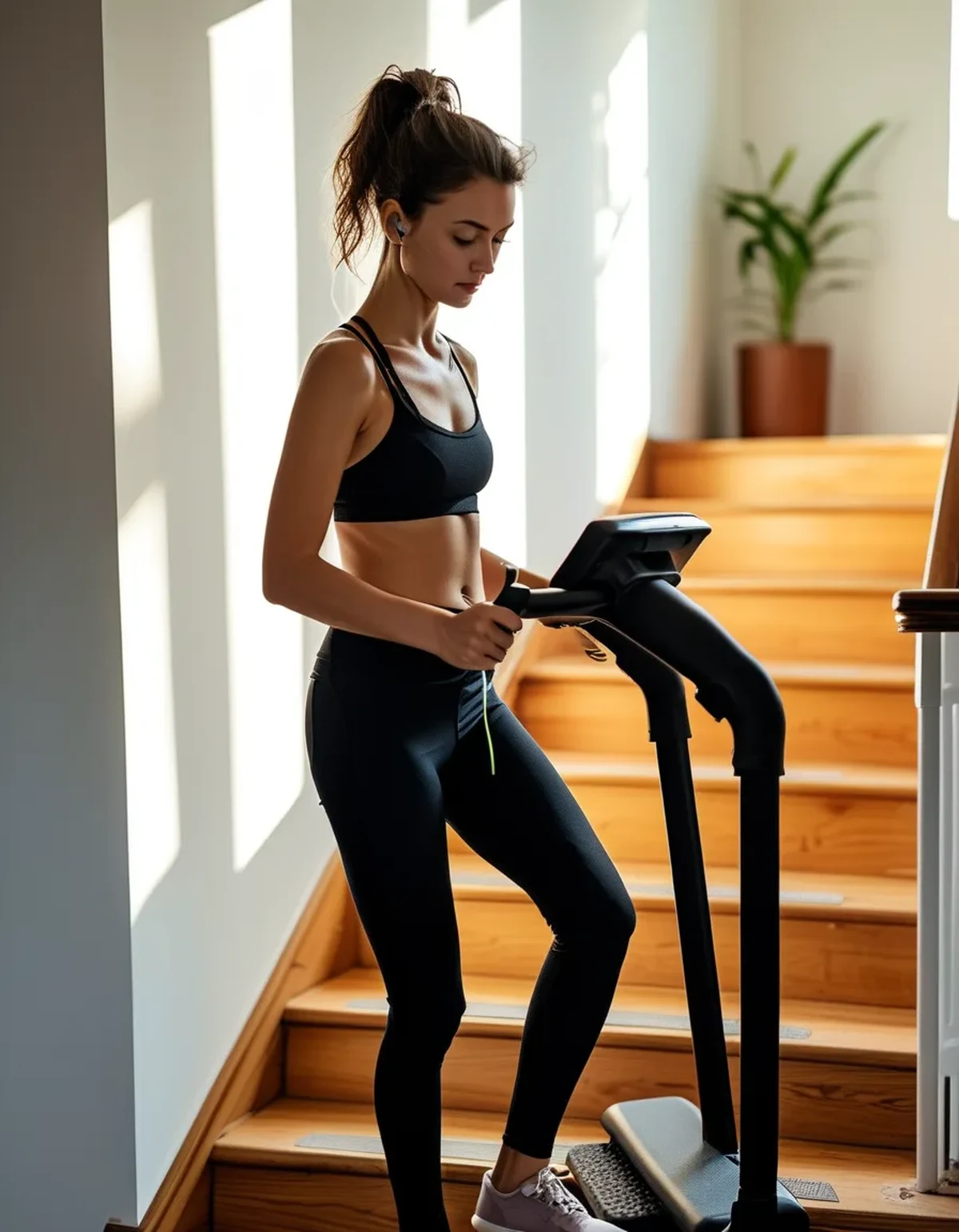
A mini stepper has almost no vertical displacement of your center of mass. Your legs move, alternately compressing hydraulic cylinders, but your body stays at roughly the same height. The resistance replaces gravity as the thing you are working against, and it is a considerably smaller thing.
Which is why the machine’s calorie display is optimistic. Those numbers are typically generated from step count and generic assumptions rather than from your bodyweight and actual resistance, and they are among the least reliable readouts in home fitness equipment.
The muscle pattern differs too. Real stair climbing loads the glutes and hamstrings substantially during the push-up phase; a mini stepper, particularly at low resistance, biases toward the quads and calves because there is no bodyweight to extend the hip against.
And the eccentric phase is missing entirely. Descending stairs is where a great deal of the muscular load and next-day soreness comes from, and a stepper has no equivalent - which is a benefit for the joints and a genuine reduction in total stimulus.
Where the mini stepper genuinely wins
Frequency, which usually beats intensity for total weekly output. A stepper that lives under your desk gets used four times a day. A staircase requires a decision, and decisions are where consistency dies.
Joint comfort. No impact and no eccentric descent makes it usable for people whose knees do not tolerate stairs, and usable on consecutive days without accumulating soreness.
Multitasking is real value. You can genuinely step while taking a call or reading, which converts otherwise sedentary time into low-level activity. Over a week that NEAT contribution can exceed what a couple of stair sessions would add.
Weather and privacy. It works in August humidity and in a small apartment, at any hour, without being seen.
And progression is available if you use the resistance. Most people leave a stepper on its lowest setting for years, which is the main reason they conclude it does not work. Raising resistance until 15 minutes is genuinely hard changes what the machine is.
How to make a stepper harder, in order of effect
Raise the hydraulic resistance first. This is the largest single lever and the most commonly ignored one. Set it so that you cannot comfortably hold a conversation after five minutes.
Push through the whole foot and complete each step. Short partial steps at high cadence feel busy and do very little. A full range with a deliberate push through the heel recruits the glutes far better.
Slow down and press harder. Cadence feels like effort and load produces adaptation. Fewer, harder steps outperform faster, lighter ones on a machine with fixed resistance.
Add intervals. Two minutes hard, one minute easy, repeated eight times, produces a substantially different cardiovascular stimulus than 25 continuous easy minutes.
Use the arm bands only if they are not taking load off your legs, which is what usually happens. On most units the bands are a distraction rather than an addition.
And check the talk test rather than the screen. If you can hold a full conversation comfortably, the resistance is too low no matter what the calorie display claims.
Myth vs Fact: Steppers and Stairs
Myth: a mini stepper is the same as stair climbing. Fact: no vertical displacement means substantially less work. The movement pattern is similar; the energy cost is not.
Myth: the calorie counter is roughly right. Fact: it typically does not know your weight or your real resistance setting, and is among the least accurate displays on any home machine.
Myth: a stepper cannot build any strength. Fact: at high resistance with full range, it produces a real muscular stimulus in the quads and calves - just less through the glutes than stairs do.
Myth: more steps per minute is better. Fact: with fixed hydraulic resistance, cadence increases the feeling of effort more than the load. Slower and harder does more.
Myth: you have to pick one. Fact: the sensible answer for most people is both - stairs two or three times a week for intensity, the stepper daily for volume and for turning sitting time into moving time.
FAQ: Steppers vs Stairs, Answered
Which burns more calories per minute?
Stairs, clearly, because you are lifting your bodyweight against gravity. A stepper at high resistance closes some of the gap but does not eliminate it.
Is a stepper enough on its own?
For general activity and cardiovascular health, used regularly and at real resistance, it contributes meaningfully. For a strong training stimulus, pair it with something that loads the glutes and hips properly.
Why do my calves burn so much more on the stepper?
Usually foot placement - stepping through the ball of the foot rather than the whole foot shifts the work to the calves. Place the whole foot and push through the heel.
How long should a session be?
Fifteen to twenty minutes at a resistance that makes conversation difficult beats forty minutes on the lowest setting.
Are stairs bad for my knees?
Climbing is generally well tolerated; descending is the harder part. Walking down slowly with a rail manages most of it, and existing knee pain is worth having assessed rather than testing. This is general information, not medical advice.
TL;DR:
- Stairs raise your bodyweight against gravity, costing two to three times what walking does; a mini stepper has almost no vertical displacement and costs considerably less.
- Stairs load the glutes and hamstrings more, and include an eccentric descent phase the stepper lacks entirely.
- The stepper wins on frequency, joint comfort, multitasking, and weather - which over a week can add up to more total activity.
- Raise the resistance, take full steps through the whole foot, and go slower rather than faster.
- Ignore the calorie display and use the talk test instead.
Most people do not need to choose: stairs a few times a week for intensity, the stepper daily for volume.
Keep Reading
This article is for general informational and styling purposes only. Fit, sizing, and product availability may vary.