Why Mini Stepper Calorie Numbers on the Screen Are Wrong
Quick Answer: Budget fitness equipment calorie displays use generic formulas that don’t account for your actual weight, age, sex, or fitness level, and are frequently overestimated by 20-40% compared to more accurate methods like a validated heart rate-based calculation.
The display says 300 calories after 20 minutes. That number feels great — and it’s very likely wrong, sometimes by a significant margin.

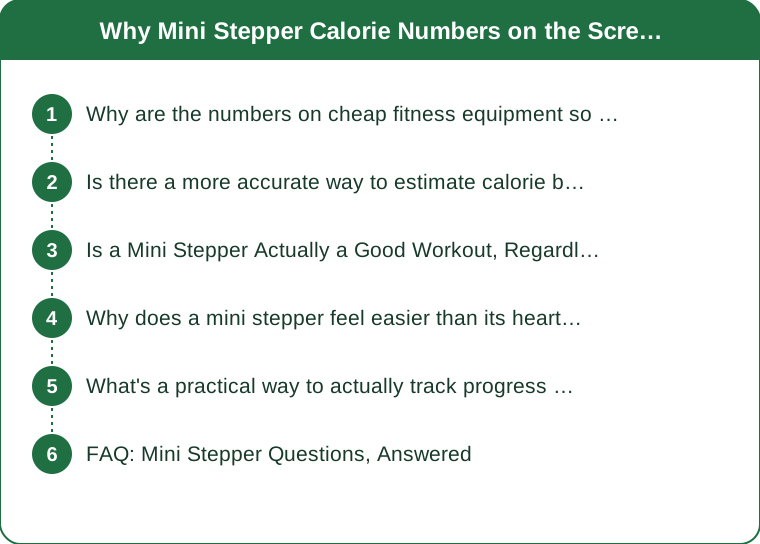
Why are the numbers on cheap fitness equipment so often wrong?
Most budget equipment calorie estimates use a simplified, one-size-fits-all formula based only on time and step count or resistance level, without factoring in your actual body weight, age, or true effort level — all of which significantly affect real calorie burn. Two people of very different sizes doing an identical session get the same number, which is a clear sign the formula isn’t personalized.
Is there a more accurate way to estimate calorie burn on a mini stepper?
A heart rate-based estimate, using a chest strap or accurate wrist monitor alongside your actual age, weight, and sex, provides a meaningfully better estimate than a generic machine display, since calorie burn correlates closely with heart rate relative to your personal max.
Is a Mini Stepper Actually a Good Workout, Regardless of the Calorie Count?
Yes, independent of the calorie number’s accuracy — a mini stepper elevates heart rate, engages major lower body muscles, and provides genuine cardiovascular benefit when used at a real effort level. The inaccurate calorie count doesn’t diminish the workout’s actual value; it’s a separate measurement problem.

Why does a mini stepper feel easier than its heart rate suggests?
Seated or low-range stepping motion recruits muscle in a way that can feel less demanding subjectively than the cardiovascular system is actually working, especially compared to weight-bearing activities like walking where perceived effort and heart rate track more closely. This mismatch means the workout may be doing more than it feels like it’s doing.
What’s a practical way to actually track progress on a mini stepper?
Track consistent, comparable metrics instead of trusting the calorie display: total step count, session duration, and heart rate range (if you have a monitor) all provide more meaningful week-over-week comparison than an inflated calorie estimate.
FAQ: Mini Stepper Questions, Answered
Is a mini stepper worth buying for small spaces?
Yes, for low-impact, space-efficient cardio — just don’t rely on the built-in calorie counter as an accurate number.
How long should you use a mini stepper each day for benefit?
15-20 minutes of continuous, moderately challenging effort provides real cardiovascular benefit; longer sessions add more but aren’t required for baseline benefit.
Does resistance level on a mini stepper meaningfully change calorie burn?
Yes — higher resistance increases muscular effort and heart rate response, which does increase real calorie burn, even though the displayed number’s absolute accuracy remains questionable.
TL;DR:
- Budget equipment calorie displays use generic formulas that ignore your actual weight, age, and effort
- A heart rate-based estimate is meaningfully more accurate than the machine’s number
- The workout’s real value doesn’t depend on the calorie count being correct
- Track steps, duration, and heart rate range instead for meaningful progress comparison
Ignore the number on the screen — the workout is doing more (or sometimes less) than it claims either way.
Keep Reading
This article is for general informational and styling purposes only. Fit, sizing, and product availability may vary.