Why Mini Stepper Workouts Feel Easier on Some Days for the Exact Same Effort
Quick Answer: A mini stepper’s perceived effort shifts day to day mainly due to sleep quality, recent caffeine intake, hydration status, and how warmed-up the body is before starting — the machine’s resistance setting stays constant, but the body’s actual capacity and perceived exertion at that setting genuinely varies, which is why the same 20 minutes can feel routine one day and surprisingly hard the next.
The stepper’s resistance dial hasn’t changed between sessions, but the body doing the stepping genuinely has, in ways that are mostly predictable once identified.

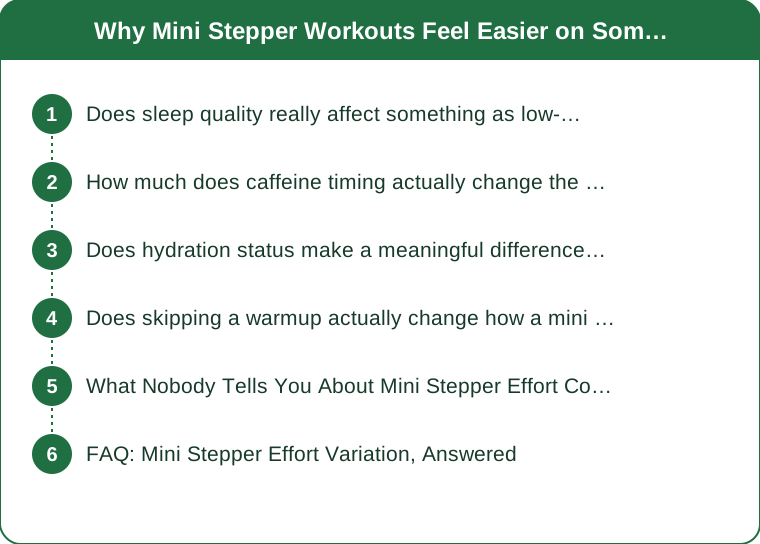
Does sleep quality really affect something as low-impact as a mini stepper session?
Yes — poor sleep measurably increases perceived exertion for a given level of physical activity, meaning the same resistance and pace on a mini stepper can feel noticeably harder after a poor night’s sleep, even though the actual physical demand on the body hasn’t changed. This effect applies to low-impact activity like stepping just as much as it does to higher-intensity training.
How much does caffeine timing actually change the perceived difficulty of a session?
Caffeine consumed 30-60 minutes before exercise is well-documented to reduce perceived exertion at a given workload, which is part of why a stepper session done shortly after coffee often feels easier than the same session done without any caffeine in the system. Sessions done later in the day, well past a morning coffee’s effect, can feel comparatively harder purely due to this timing difference.
Does hydration status make a meaningful difference for a relatively low-intensity activity like this?
Yes — even mild dehydration measurably increases perceived exertion and can raise heart rate for a given workload, an effect that applies across activity intensities, including lower-impact cardio like a mini stepper. A session started already mildly dehydrated, common if it’s the first activity of the day before any water intake, can feel meaningfully harder than an identically-paced session done well-hydrated.

Does skipping a warmup actually change how a mini stepper session feels?
Yes — starting at full working pace without a brief warmup period means the cardiovascular system hasn’t had time to gradually increase blood flow and readiness, which tends to make the first several minutes of a session feel disproportionately hard compared to sessions that ease in over 2-3 minutes first. This effect is often mistaken for the workout itself being harder that day, when it’s really a warmup gap.
What Nobody Tells You About Mini Stepper Effort Consistency
Perceived effort on a mini stepper is a notoriously unreliable measure of actual calorie burn or cardiovascular benefit, since so many external factors shift the perception without changing the underlying workload — this is exactly why the display’s calorie estimate and subjective difficulty can both mislead, and tracking heart rate directly gives a far more consistent read on the actual training effect from session to session.
FAQ: Mini Stepper Effort Variation, Answered
Is it worth adjusting resistance day to day based on how hard a session feels?
Not necessarily — since perceived difficulty is influenced by so many external factors, keeping resistance consistent and instead tracking heart rate or a set pace gives a more reliable long-term progression signal than adjusting based on daily feel alone.
Does time of day affect how hard a mini stepper session feels?
Yes, to some degree — body temperature and alertness naturally fluctuate through the day, and sessions done in a low-energy window (like right after a big meal, or very early morning) often feel harder regardless of actual fitness level.
Should a harder-feeling session be cut short, or pushed through?
As long as there’s no pain or medical concern, pushing through a harder-feeling but otherwise normal session is generally fine — the perceived difficulty spike from these factors doesn’t indicate an actual injury risk on a low-impact machine like a mini stepper.
TL;DR:
- Sleep quality, caffeine timing, hydration, and warmup all shift perceived effort independent of the resistance setting
- The stepper’s difficulty stays constant even when a session feels noticeably harder or easier
- Heart rate tracking gives a more consistent effort measure than subjective feel or the display’s calorie estimate
- A harder-feeling session is usually fine to push through rather than a sign the workout itself changed
A mini stepper session that feels unusually hard isn’t a sign of lost fitness — it’s almost always one of a few predictable, temporary factors quietly shifting how that same resistance level feels that day.
Keep Reading
This article is for general informational and styling purposes only. Fit, sizing, and product availability may vary.