Why Your Mini Stepper Gets Noticeably Easier After Five Minutes
Quick Answer: Most mini steppers use hydraulic cylinders, and hydraulic fluid thins as it warms. In the first three to five minutes of use the fluid heats from room temperature, viscosity drops, and the cylinder offers measurably less resistance for the same pedal speed. It is a real mechanical change, not a perception shift — which is why raising the resistance setting after five minutes is the right move rather than a sign you are getting fitter mid-session.
The first two minutes feel like work. By minute six the pedals are moving through butter and you are wondering whether you got softer in the last four minutes.
You did not.
The machine did.
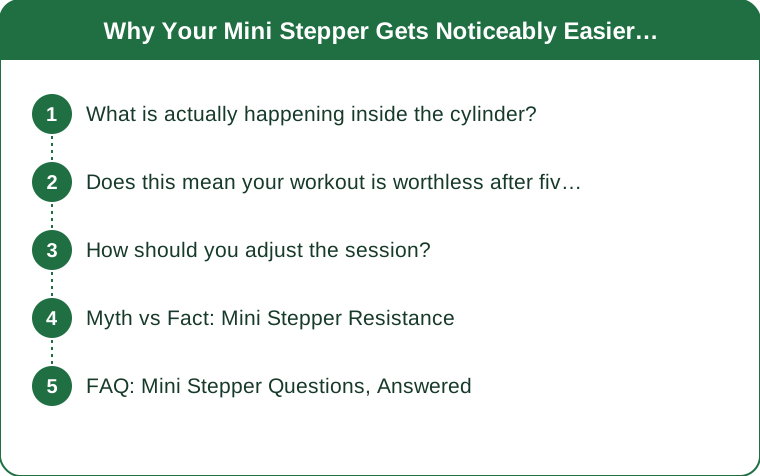
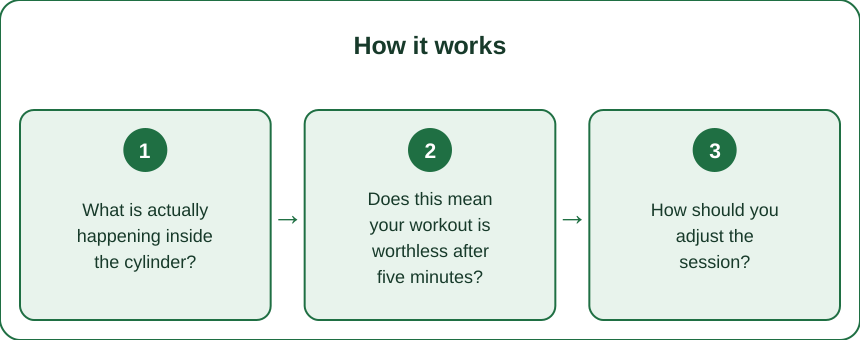
What is actually happening inside the cylinder?
A straightforward physical property, working exactly as designed and nobody mentions it in the manual.
Hydraulic cylinders resist by forcing fluid through a small orifice. Push the pedal down, the piston forces oil through a restriction, and the restriction is what you feel as resistance.
Fluid viscosity drops as temperature rises. This is a well-known property of hydraulic oils. A cylinder starting at 20°C room temperature and warming to 35 to 45°C during use will pass fluid noticeably more easily at the end than at the start.
The work you do generates the heat. Forcing fluid through a restriction converts mechanical work into heat, which is why the cylinders are warm to the touch after a session. You are heating your own resistance away.
Equilibrium arrives around four to eight minutes. After that the cylinder reaches a rough thermal steady state and resistance stabilises for the rest of the session.
Ambient temperature shifts the whole curve. A stepper used in a cold garage in November starts stiffer and takes longer to warm than one in a heated living room. This is the actual reason a machine feels different in different rooms and different seasons.
Cylinder wear changes it permanently. Over months, seals wear and internal clearances open up. A stepper that has become permanently easy is not being generous — the cylinders are near the end of their life.
Does this mean your workout is worthless after five minutes?
No, but it does mean the first five minutes and the last twenty are not the same workout, and you should plan around it.
Your body is warming up on the same timeline. Muscle temperature, blood flow and joint fluid all improve over the first five to ten minutes, so some of the easing is genuinely you. The two effects overlap and neither cancels the other.
Heart rate is the honest measure. If your heart rate holds steady while the resistance feels lighter, you are compensating with speed. If your heart rate drops, the workout has genuinely eased off.
Cadence usually rises to compensate automatically. Most people unconsciously step faster as resistance falls, which partly maintains intensity. Watch your step counter — the rate usually climbs by 10 to 20 percent across the session.
The screen calorie count does not know any of this. Mini stepper consoles typically estimate from step count and a generic assumption, with no resistance sensor at all. The number was already unreliable and this makes it worse.
A five minute cold start is a decent warm-up by accident. The stiffer initial resistance at a slower cadence is a reasonable ramp-in, so the design flaw is functionally useful for the first block.

How should you adjust the session?
Treat the first five minutes as a warm-up block, then set resistance for the real work.
Set resistance low for the first five minutes, then raise it one or two levels. This is the single most useful change and it takes four seconds mid-session on most machines.
Or plan the session in three blocks. Five minutes easy, fifteen minutes at the raised setting, five minutes easy. Same duration, considerably more work.
Use cadence targets rather than feel. Feel is the thing being corrupted here. Pick a steps-per-minute target — 80 to 110 is a common working range — and hold it against the clock.
Check heart rate at minute 5 and minute 15. If minute 15 is lower, raise the resistance. This is a two-data-point session review and it takes no effort.
Let the machine warm up before a short session. If you only have ten minutes, two minutes of easy stepping before you start counting means your ten minutes are done at consistent resistance.
Run it in a warmer room in winter. A stepper in an unheated space stays stiff longer, and while that sounds like more resistance it usually means an uneven session and more strain on cold joints.
Seasonal note: as autumn arrives and indoor sessions replace outdoor walking, the mini stepper goes from occasional to primary cardio for a lot of people. That is exactly when a session structured around this quirk stops being a curiosity and starts being worth several hundred calories a week.
Myth vs Fact: Mini Stepper Resistance
Myth: The stepper feels easier because you are getting fitter. Fact: Not within five minutes. Fitness adaptation takes weeks. Fluid viscosity changes in minutes.
Myth: Higher resistance always means a better workout. Fact: Very high resistance reduces cadence and often shifts the work to the calves rather than the legs and heart. A moderate setting held at a decent cadence usually produces more cardiovascular work.
Myth: The console calorie figure is roughly right. Fact: It has no resistance input and no idea what you weigh unless you told it. Treat it as a session comparison number at best.
Myth: If it feels easy, it is doing nothing. Fact: Steady low-intensity work has real value, particularly for daily movement volume. Just do not confuse it with a hard session.
Myth: All mini steppers work this way. Fact: Hydraulic ones do, and they are the majority. Magnetic-resistance models are far more stable, which is one genuine reason to pay more.
Myth: A stepper that has gone permanently soft can be adjusted. Fact: If raising to maximum no longer produces real resistance, the cylinders are worn. That is a replacement, not a setting.
FAQ: Mini Stepper Questions, Answered
How long do hydraulic cylinders last?
Commonly one to three years of regular use depending on user weight and session frequency. Progressive softening and any oil weeping around the cylinder are the signs.
Should I buy a magnetic stepper instead?
If consistency matters to you and the budget allows, yes — magnetic resistance does not drift with temperature. Hydraulic is cheaper and perfectly usable if you structure around this.
Is it bad for the machine to use it cold?
No, but starting at a lower resistance for the first few minutes is easier on both the cylinders and your joints.
Why does one pedal feel harder than the other?
Uneven cylinder wear, or one cylinder warming faster because of how you distribute weight. If it persists when cold and warm, the cylinders are wearing unevenly.
Does the same effect happen on a walking pad?
No. Motorised treadmills and walking pads hold speed electronically, so they do not drift the same way.
What resistance setting should I use?
Whatever lets you hold 80 to 110 steps per minute for the working block without your calves taking over. Then raise it a notch once the machine warms.
TL;DR:
- Hydraulic cylinders thin as they heat, so resistance genuinely drops over the first four to eight minutes.
- Your body warms on the same timeline, so the two effects overlap — heart rate is the honest measure.
- Structure it: five minutes easy, then raise resistance one or two levels for the working block.
- Use a cadence target of 80 to 110 steps per minute instead of relying on feel.
- Permanently soft at maximum setting means worn cylinders, not a settings problem.
The machine gets easier before you do. Move the lever at minute five.
Keep Reading
This article is for general informational and styling purposes only. Fit, sizing, and product availability may vary.