Why Your Mini Stepper Stopped Feeling Hard
Quick Answer: Your stepper stopped feeling hard because you adapted — which is the point. Progress it by increasing cadence in timed intervals, adding a loaded vest or dumbbells, raising the resistance knob, extending duration in 5-minute increments, or adding an incline surface under the front. Cadence intervals give the biggest return for the least equipment.
Week one it was genuinely difficult. Your calves complained. Twenty minutes felt like an accomplishment.
Week six, you are watching a full episode and barely noticing.
This is not the machine failing. It is your cardiovascular system doing precisely what you asked it to do — and it means you now need a different input.

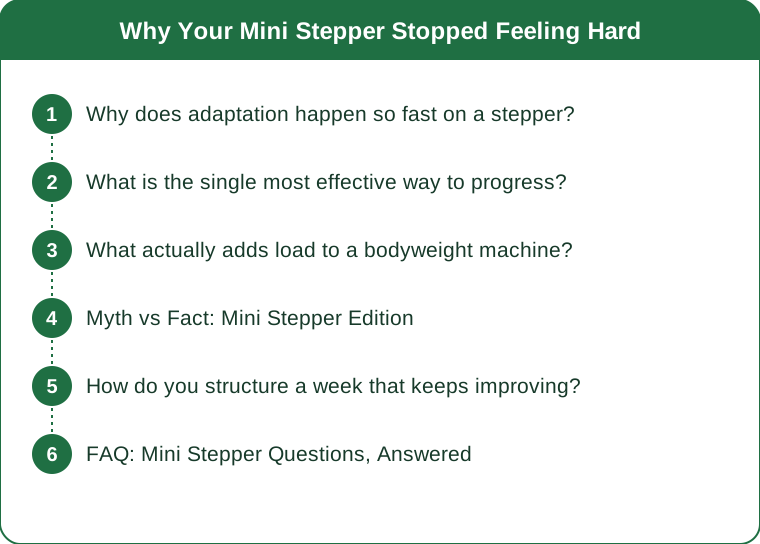
Why does adaptation happen so fast on a stepper?
Because the movement pattern is fixed and the load is capped, so you exhaust the variables quickly.
A mini stepper has a narrow range of demand: your body weight, a fixed range of motion, and whatever hydraulic resistance the knob provides. Once your aerobic system adapts to that specific demand — usually within four to eight weeks — there is nowhere further for it to go on its own.
Running and cycling avoid this because speed and terrain scale indefinitely. A stepper’s ceiling arrives sooner.
Two things adapt in parallel:
- Cardiovascular efficiency. Your heart delivers oxygen more effectively at the same output, so the same work costs less effort.
- Movement economy. You get smoother. The wasted energy of an unfamiliar pattern disappears, and with it a meaningful share of the calorie cost.
The second one is underrated. A lot of the “it feels easier” sensation is simply that you have gotten better at stepping, independent of fitness.
What is the single most effective way to progress?
Cadence intervals. No equipment, no purchase, immediate effect.
Instead of stepping steadily for 20 minutes, alternate:
The basic protocol: 1 minute at a pace you genuinely cannot sustain, 2 minutes easy. Repeat six times. Add a 3-minute warm-up and cool-down. Total 24 minutes, and it is dramatically harder than 24 steady minutes.
Progression path over six weeks:
- Weeks 1–2: 1 minute hard / 2 minutes easy, six rounds
- Weeks 3–4: 1 minute hard / 90 seconds easy, seven rounds
- Weeks 5–6: 90 seconds hard / 90 seconds easy, seven rounds
“Hard” on a stepper means fast cadence with full range of motion, not short frantic bouncing. Partial-range fast stepping looks intense and does considerably less. Keep the full depth and drive through the whole step.
This works because interval training targets a different adaptation than steady work does — and it is exactly the adaptation your steady sessions have stopped providing.
What actually adds load to a bodyweight machine?
Four options, roughly in order of value:
A weighted vest. The most effective addition by a wide margin. Ten to twenty pounds distributed on your torso increases the work at every single step without changing your mechanics. Start at 10 pounds and add slowly — it loads the knees and ankles as well as the lungs.
Dumbbells in your hands. Cheaper if you already own them, and adding arm movement — presses, curls, lateral raises — while stepping raises heart rate substantially. The tradeoff is that grip fatigues before your legs do, which caps the useful weight around 5 to 8 pounds per hand.
The resistance knob, actually used. Most people set it once and never revisit it. Increasing hydraulic resistance makes each step harder and slows your cadence, which is a different stimulus than going faster. Alternate between high-resistance slow work and low-resistance fast work across the week.
Raising the front. Placing the front of the stepper on a sturdy book or low platform changes the angle and shifts more work into the glutes. Only do this if the machine remains completely stable — a tipping stepper is not worth the extra stimulus.
The vest is where most people should start. It is boring, it is effective, and it does not require you to change anything else.

Myth vs Fact: Mini Stepper Edition
Myth: If it feels easy, it is not doing anything. Fact: Easy steady work still supports cardiovascular health, recovery, and daily movement volume. It is just no longer improving your fitness ceiling. Those are different goals and both are legitimate.
Myth: Mini steppers are not a real workout. Fact: A properly loaded interval session on a stepper produces heart rates comparable to jogging. The machine’s reputation comes from how most people use it — steadily, gently, while watching television — not from its capability.
Myth: More minutes is the way to progress. Fact: Duration has the worst return of any variable here. Going from 20 to 40 minutes doubles your time investment for a modest increase in stimulus. Intensity changes cost nothing extra in time.
Myth: The calorie counter on the display is roughly accurate. Fact: These displays typically overestimate substantially, sometimes by 30 percent or more, and they cannot account for your weight, added load, or cadence. Use it to compare sessions to each other, never as an absolute number.
Myth: You need a bigger machine to keep progressing. Fact: A weighted vest and interval structure will outlast almost anyone’s need for an upgrade. The limitation is usually programming, not hardware.
How do you structure a week that keeps improving?
Three sessions with different purposes beats three identical ones.
Session 1 — Intervals. The cadence protocol above. This is the session that drives improvement, so put it on your best-rested day.
Session 2 — Loaded steady. Weighted vest, moderate pace, 25 to 30 minutes. Different stimulus, builds work capacity, and it is genuinely pleasant.
Session 3 — High resistance, slow. Turn the knob up, step deliberately and deeply for 20 minutes. This is closer to strength endurance and it hits the glutes and calves in a way the fast sessions do not.
Track one number per session: total steps, or steps in your hard minutes. Progress on a stepper is invisible without a number, which is a large part of why people plateau and then lose interest.
Two practical notes: check the hydraulic cylinders every couple of months — they wear out and resistance genuinely degrades over time, so sometimes the machine really did get easier. And vary your foot position occasionally, moving slightly forward or back on the pedals, which shifts emphasis between calves and glutes.
This is general information, not medical advice. Knee or ankle pain that persists warrants a professional look rather than a programming change.
FAQ: Mini Stepper Questions, Answered
How many minutes should I actually be doing?
Twenty to thirty minutes at appropriate intensity is plenty. If you are stepping for an hour and it feels comfortable, intensity is the missing variable, not duration.
Do the resistance bands that come with steppers do anything useful?
They add modest upper-body work and raise heart rate a little. They are not a strength stimulus for anyone past a beginner stage. Light dumbbells accomplish more if you want to load the arms.
Is a mini stepper enough on its own?
For cardiovascular health, it can be. For overall fitness it is missing resistance training for the upper body and any real loading of the posterior chain. Pair it with two short strength sessions and the combination covers most bases.
TL;DR:
- Getting easier means you adapted — the machine did not fail, its variables ran out.
- Cadence intervals are the highest-value fix and cost nothing: 1 min hard / 2 min easy, six rounds.
- A 10–20 lb weighted vest is the best equipment addition; the resistance knob is the most neglected.
- Duration is the weakest lever. Intensity changes cost no extra time.
- Run three different session types weekly and track one number, or progress becomes invisible.
The nice thing about a plateau on a small machine is that the fix is entirely in how you use it. Most people have never actually tried to make a stepper hard, and it turns out it can be.
Keep Reading
This article is for general informational and styling purposes only. Fit, sizing, and product availability may vary.